
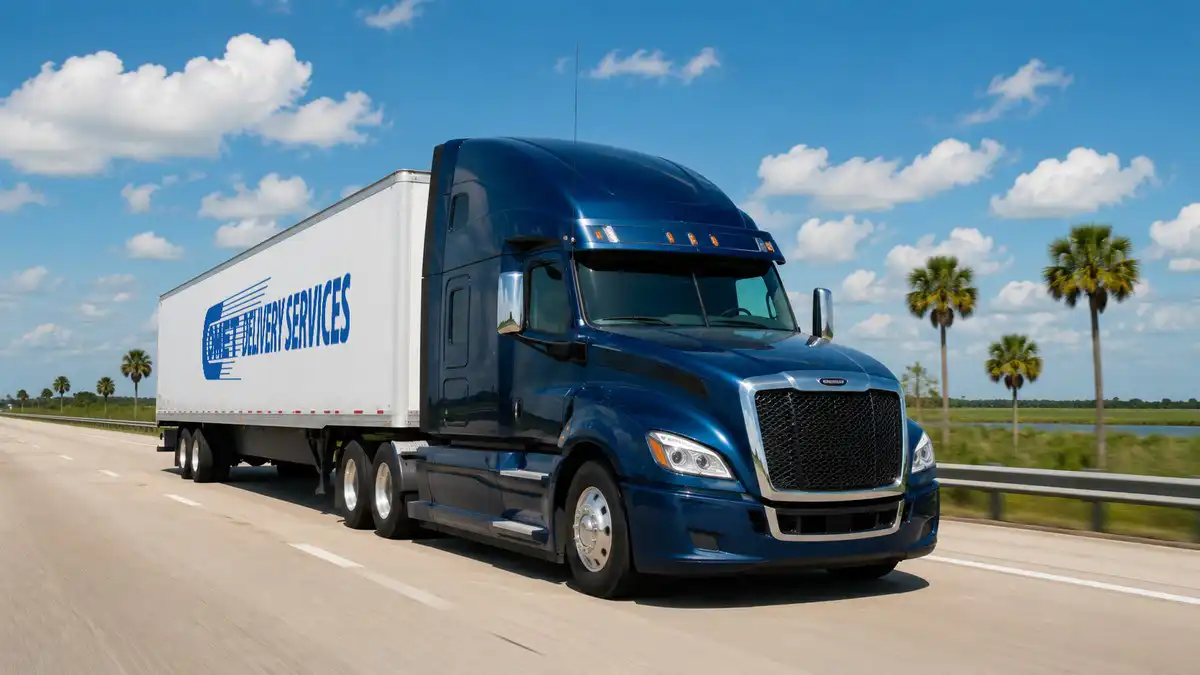
When you ship freight across Florida, the space between two cities is where things tend to go wrong. A pallet gets handed off to a partner carrier, sits on someone else’s dock overnight, rides on a truck shared with a dozen other shippers, and by the time it arrives you have lost visibility, lost time, and taken on risk you never signed up for. That gap between origin and destination is exactly what our Miami to Orlando linehaul, the Hub-to-Hub Linehaul service, was built to close.
Comet runs hubs in Miami and Orlando, and the new Miami to Orlando linehaul between them ties those two operations into one continuous line of movement. Your freight leaves one hub and arrives at the other on dedicated equipment we run, handled by our own people, start to finish. For print, manufacturing, and retail shippers moving volume between South Florida and Central Florida, that continuity is the whole point.
What Linehaul Actually Means
Linehaul is the scheduled line movement of freight between two fixed points. In our case those points are the Miami hub and the Orlando hub, and the schedule runs both directions on a consistent basis. It is not an ad hoc dispatch squeezed in between other jobs. It is a planned, repeatable leg of the network you can build your own operation around.
The distinction matters because most freight moving across a state gets brokered, transferred, and consolidated along the way, with each touch adding a point where something can be delayed or mishandled. Our linehaul removes those intermediate touches. The truck that picks up in Miami is the truck that delivers in Orlando, and the reverse is just as true. That turns two separate hubs into one connected system rather than two ends of a broker’s chain.
Why Running Both Hubs Changes Everything
Plenty of carriers can get a load from Miami to Orlando. Very few can do it without handing your freight to someone else at some point in the trip. The difference comes down to owning both ends of the lane. Because Comet operates both the Miami hub and the Orlando hub, we control the freight from the moment it enters our dock to the moment it leaves the other one.
That end-to-end control is the foundation of how we work. Comet has been a dedicated carrier since 1977, which means single-customer trucks with no commingled freight. Your shipment is not sharing trailer space with unrelated cargo or staged alongside loads from shippers you have never met. When we run your freight down the linehaul, it stays yours, on our equipment, the entire way, a level of custody you cannot get when the middle leg belongs to a partner carrier.
The I-4 Corridor and Central Florida Growth
The physical line between our two hubs is the I-4 corridor, and there may be no busier stretch of freight geography in the state right now. Central Florida has become one of the fastest growing logistics markets in the country, with distribution centers, manufacturers, and retailers planting flags around Orlando to reach its expanding population. Every one of those operations needs a reliable way to connect back to the ports, warehouses, and suppliers concentrated in South Florida.
That is precisely the movement our linehaul serves. As more of our customers build out their Orlando footprint, the Miami to Orlando lane has become one of the most important routes we run. A print client can hold inventory in Miami and feed a Central Florida account on a set schedule, while a manufacturer pulls components north without gambling on a spot-market carrier. The corridor is growing, and the linehaul grows with it.
Reliability You Can Schedule Around
Consistency is what separates the Miami to Orlando linehaul from a one-off long haul. Because the service runs on a set cadence between the hubs, you can plan production, replenishment, and delivery windows against it instead of reacting to whatever capacity happens to be available on a given day. That predictability is worth more than most shippers realize, until they lose it to a brokered load that missed its window.
Dedicated capacity is what makes that predictability possible. When a truck belongs to your freight rather than the highest bidder, its schedule belongs to you too. For businesses running tight print deadlines or lean manufacturing schedules, that reliability is the difference between a supply chain that hums and one that has to be managed by hand.
Security From One End to the Other
Keeping freight on the same trucks and drivers for the entire lane is not only about speed and scheduling. It is also about security. Every handoff to an outside carrier is a break in the chain of custody, and every break is a place where cargo can be exposed, misrouted, or lost track of. Our linehaul has no such breaks, because there is no outside carrier in the middle.
Our drivers carry TSA and TWIC credentials, so the same people trusted at secured facilities and port terminals are the ones moving your freight up and down the corridor. As a US Customs Bonded Carrier, we can also move in-bond freight along the line when your shipment calls for it. For shippers who care about who is touching their goods, unbroken custody from hub to hub is a security posture no brokered arrangement can match.
Who Relies on the Miami to Orlando Linehaul
The shippers who get the most out of the linehaul are the ones with real volume moving between the two ends of the state. Print operations hold stock in one market and serve accounts in the other on a dependable schedule. Manufacturers keep components and finished goods flowing without exposing time-sensitive freight to the spot market. Retailers balance inventory between South Florida and Central Florida so neither region runs short.
What ties those customers together is a need for freight that shows up when it should, handled by a carrier that treats the whole trip as its own responsibility. The linehaul gives them a fixed, dedicated leg they can build a schedule around.
Where the Linehaul Fits in Your Freight Strategy
The Hub-to-Hub Linehaul does not stand alone. It plugs into everything else Comet does, from dedicated and LTL trucking to warehousing, cross-docking, and drayage at both ends of the state. Freight can land at the Miami hub off a port move, ride the line to Orlando, and roll straight into a Central Florida delivery without ever leaving Comet’s hands.
If you are moving volume between South Florida and Central Florida, or planning to as your Orlando presence grows, the Miami to Orlando linehaul is worth a conversation. Contact us to talk through your lanes and volumes, and take a look at the story behind Comet to see why shippers have trusted us to move their freight ourselves since 1977.
