
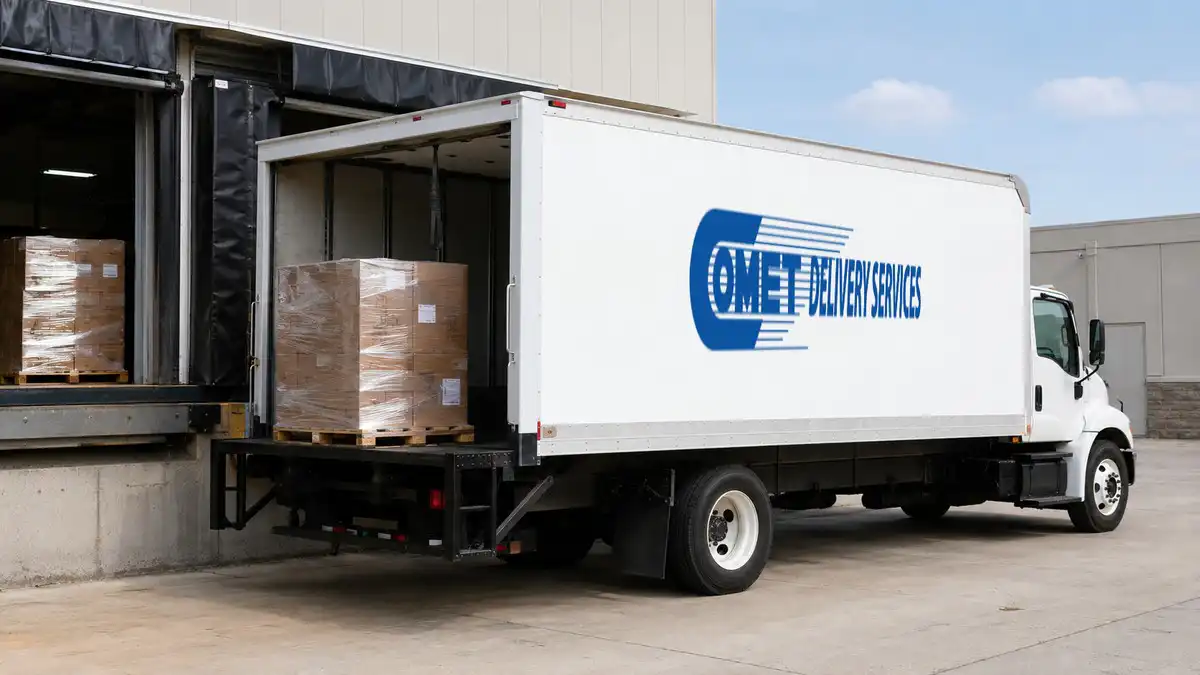
When a carrier tells you a shipment is “dedicated,” it can sound like marketing language. In practice it describes something very specific about how your freight moves, who touches it, and how much control you keep from pickup to delivery. For print runs, manufacturing components, and retail inventory, that difference shows up in whether the load arrives intact and on the day you actually needed it. Dedicated trucking is the arrangement behind that control, and it works nothing like shared freight or a brokered load.
Dedicated trucking has been the core of how Comet Delivery works since 1977, and it is the backbone of our dedicated delivery service. It is worth spelling out what the term means, how it contrasts with less-than-truckload freight and with handing your load to a broker, and why single-customer trucks tend to protect the shipments that matter most to your business.
One Customer, One Truck
Dedicated means the truck is assigned to a single customer’s freight. Your shipment is not commingled with other companies’ pallets, and the driver is not building a multi-stop route around whatever is most convenient for the carrier that day. The truck goes from your dock to the delivery point, or back to a Comet hub if the final delivery is not immediate, and that is the entire itinerary.
That simple structure is the whole point. When a load belongs to one customer, the route serves that customer’s timing rather than the carrier’s efficiency. There is no juggling of competing delivery windows and no detour to service an unrelated stop. The freight moves direct, and the schedule you agreed to is the schedule the truck actually runs.
How Dedicated Trucking Differs From LTL
Less-than-truckload freight works the opposite way, and it exists for a good reason. LTL providers combine shipments from many customers onto shared trailers and build routes around their own network efficiency. Multiple loads are picked up and delivered in whatever sequence makes operational sense for the carrier, regardless of any single shipper’s preferred timing.
For small, non-urgent, durable freight, that trade-off can be perfectly reasonable, and Comet runs local LTL trucking for exactly those situations. The friction appears when the freight is time-sensitive or handling-sensitive. Shared routing tends to introduce more terminal stops, more transfers between trailers, and more hands on the product, which is where missed windows, added transit days, and damage creep in. Dedicated service removes those variables because there is nothing else on the truck to route around.
The Layer a Broker Adds
Using a freight broker is a different arrangement again, and the distinction is easy to miss until something goes wrong. A broker does not operate trucks and does not move your freight. A broker arranges the load, then hands it to whichever third-party carrier is available, and steps back. You are paying a middleman to find a truck, not a carrier to haul your shipment.
That layer matters most when a claim or a problem surfaces. The broker sits one step removed from the freight and from the driver who handled it, which can turn a straightforward delivery question into a chain of phone calls where the broker points to the carrier and the carrier points back to the broker. Because Comet operates the trucks and employs the drivers that move your freight, there is no intermediary between the shipment and the people accountable for it. The company that quotes the move is the company on the road with your freight and the company that answers for it.
Why Direct Routing Protects Your Freight
Every extra stop, transfer, and handoff is a chance for something to go wrong. Freight that gets cross-loaded between trailers, staged in multiple terminals, and handled by rotating crews simply has more exposure to damage, loss, and delay than freight that rides one truck from origin to destination. Dedicated routing shrinks that exposure to the minimum.
Security follows the same logic. Comet is a US Customs Bonded Carrier, and its drivers carry TSA and TWIC credentials, which is what allows them into secured facilities and port environments. When one vetted driver stays with a load the whole way, the custody chain stays short and clear. That combination of direct routing and carded drivers is a large part of why sensitive and higher-value shipments are well suited to a dedicated truck.
What This Looks Like for Print Clients
Print is unforgiving on timing. A catalog drop, a mailer, or a run of point-of-sale materials is tied to a date that does not move, and a shipment that slips by a day can miss the campaign it was printed for. Dedicated trucking keeps that print freight on a single truck against a firm window, so a job that leaves the press on schedule arrives on schedule.
Comet has moved print freight since its earliest days, including long-standing print relationships that go back to the company’s inception. Skids of printed material are also heavy and easily scuffed, so one truck and one driver reduces the handling that leads to damaged stock.
What This Looks Like for Manufacturers and Retailers
Manufacturing runs on schedule discipline. A line that is waiting on components does not care that a carrier optimized its route, and a dedicated truck lets a plant plan around a delivery it can actually count on. The same holds for finished goods moving out to the next stage of the supply chain, where a predictable departure and arrival keep production and fulfillment in sync.
Retail and business shippers live with the same pressure at the shelf. Inventory that arrives late means empty racks during a promotion, and freight that arrives damaged means product that cannot be sold. A dedicated truck, often paired with liftgate and flatbed equipment for locations without a dock, gives retailers delivery they can build a plan around rather than hope around. For many Comet clients, that reliability is a stronger reason they stay than the reason they first signed on.
Choosing Dedicated Trucking When It Fits
Not every shipment needs a dedicated truck, and the honest answer is that some freight is a fine match for LTL or an expedited run instead. The question to ask is what the load is worth to your operation if it is a day late or shows up damaged. When timing is fixed, when the freight is sensitive, or when a clean custody chain matters, a single-customer truck is usually the right call.
Comet has been answering that question for Florida shippers since 1977, operating out of its Miami hub and now Orlando, and serving the entire state. If you want to talk through whether a dedicated move fits your freight, contact us with the details of your shipment, and see how Comet has built its operation around dedicated delivery.
