
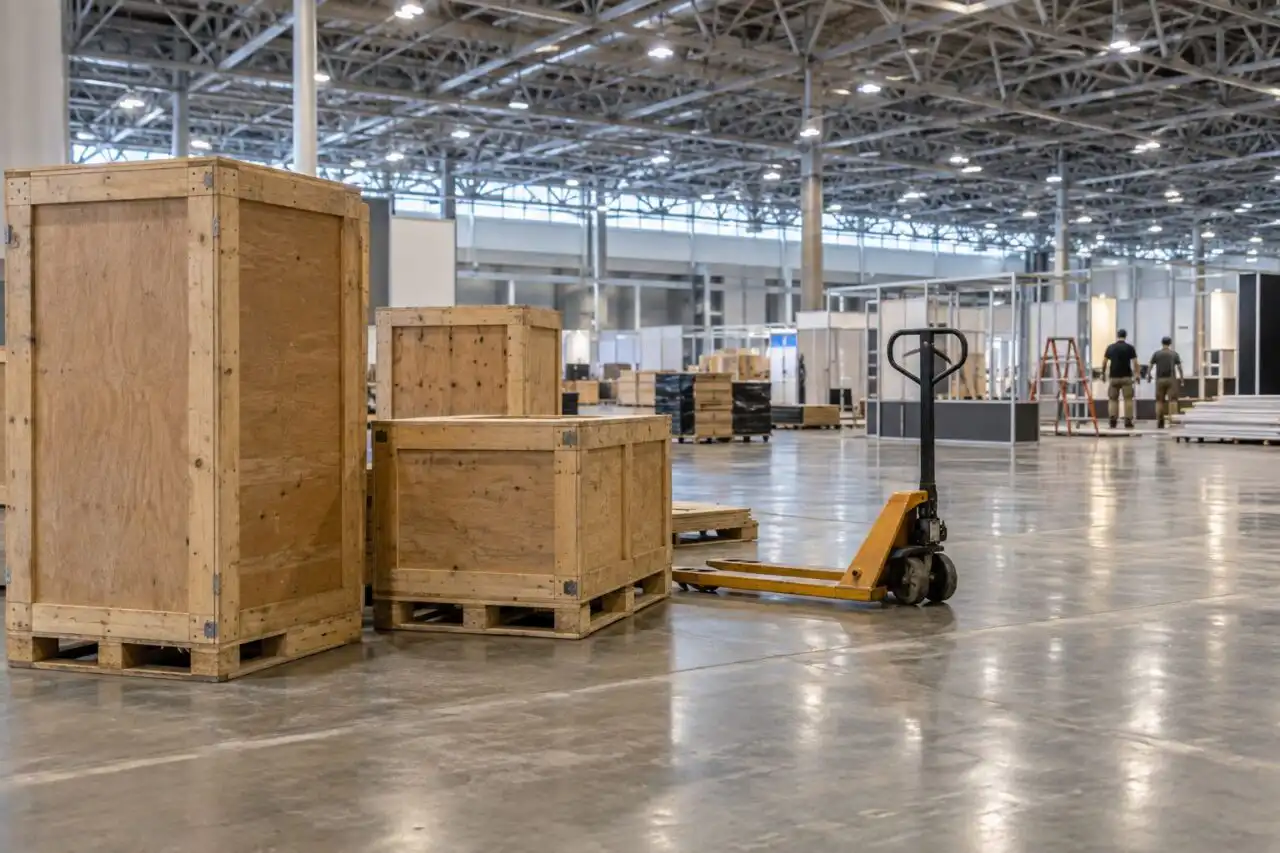
Orlando runs on conventions. Between the convention center and the resort venues, the city hosts some of the largest shows in the country, and every one of them turns on a schedule that does not move. Your booth either makes the move-in window or it does not, and the show floor opens either way.
That is what makes trade show freight different from almost everything else a carrier hauls. There is no version of a late delivery that gets quietly absorbed. A crate that misses its window sits on a dock while a crew stands on the floor with nothing to install, and the cost of that hour is measured in labor rates and lost setup time.
Why Orlando Trade Show Freight Runs on Someone Else’s Clock
Every show publishes a move-in schedule that assigns each exhibitor a target date and often a specific window inside it. Those windows exist because a show floor can only absorb so many trucks at once. Marshalling yards meter the flow, and a truck that arrives outside its window waits until there is room, which can mean hours.
The important thing to understand is that the clock belongs to the show, not to the carrier and not to you. A carrier that treats your crate as one stop on a multi stop route is optimizing for its own day. A show window does not care about that route.
What the Move-In Window Actually Demands
Hitting a window reliably takes three things. The freight has to be staged close enough to arrive on time without an overnight drive. The driver has to know the venue, the marshalling process, and which entrance actually applies to your load. And there has to be enough slack in the plan that a delay at one end does not consume the whole window.
Most missed windows are not dramatic. They are a truck that left slightly late, hit traffic on I-4, and arrived forty minutes after its slot closed. Small margins are what decide this, which is why the routing matters more than the mileage.
Where Trade Show Freight Usually Goes Wrong
The most common failure is a handoff. A load booked with one company and moved by another arrives with a driver who has never been to that venue, does not know the marshalling yard, and has no relationship with anyone on site. When something needs to be sorted out at the gate, there is nobody with authority to sort it.
The second most common failure is equipment. Booth crates are heavy, awkward, and frequently going somewhere without a dock. A liftgate on a truck is what gets a crate to the ground safely at a venue that has no dock height access, and discovering that requirement on delivery day is too late.
Advance Warehouse and Direct to Show Are Two Different Decisions
Shows generally give exhibitors both options, and they carry different risks. Shipping to the advance warehouse ahead of the show means your freight is already in Orlando, checked in, and delivered to your booth by the show contractor before you arrive. It costs more in handling, and it takes your crate out of your hands earlier.
Shipping direct to the show floor keeps the freight with your carrier until the moment it lands at the booth, which means fewer touches and more control, but it puts the whole outcome on hitting the window. Neither is automatically right. Shows with tight floors and long move-in schedules often favor the advance warehouse, while a compact setup on a short schedule can favor going direct.
Move Out Is the Harder Half
Exhibitors plan move-in carefully and then improvise move-out, which is backwards. At the end of a show, every exhibitor is tearing down at once, the aisles are full, and carriers are competing for the same dock doors. Freight that does not get picked up in the assigned period can be forced onto the show’s designated carrier at a rate nobody chose.
Planning the outbound before the show opens is the single most useful thing an exhibitor can do. That means knowing who is picking up, when the window is, and where the freight goes next, whether that is back to a warehouse, on to the next show, or into storage between events.
What Dedicated Delivery Changes for Show Freight
On a dedicated run, your freight is the only freight on the truck, so the schedule is built around your window instead of around a route with other stops in it. There is no terminal in the middle and no second carrier taking over partway, which removes the handoffs where show freight typically goes wrong.
It also means the same operation handles the load from pickup through the gate. When a marshalling yard runs long or a window shifts, the conversation happens with people who already have the load, rather than through a broker calling a carrier they have never used before. Our trade show logistics service is built around that, and for exhibitors moving fixtures and displays rather than crated booths, fixtures and FF and E delivery covers the same ground with the handling that finished displays need.
Planning an Orlando Show Around the Freight
The exhibitors who have the smoothest shows tend to work backward from the window. They confirm the move-in slot first, then set the pickup date from it with room to spare, then decide advance warehouse or direct based on how much margin that leaves. They book the outbound at the same time as the inbound. And they tell the carrier what is actually in the crate, because a fragile display and a pallet of literature are not the same delivery.
For exhibitors coming from South Florida, the freight can move up on our Miami to Orlando linehaul without changing carriers along the way, which keeps one company responsible for the load from the origin dock to the show floor.
Talk to Comet About Your Next Orlando Show
Comet runs dedicated freight across Florida from hubs in Miami and Orlando, including show freight into Orlando venues. If you have a move-in window on the calendar, the useful time to plan the freight is before the crate is packed, not the week of the show.
Contact us with your show dates and target window, or read more about Comet and how we move freight.
