
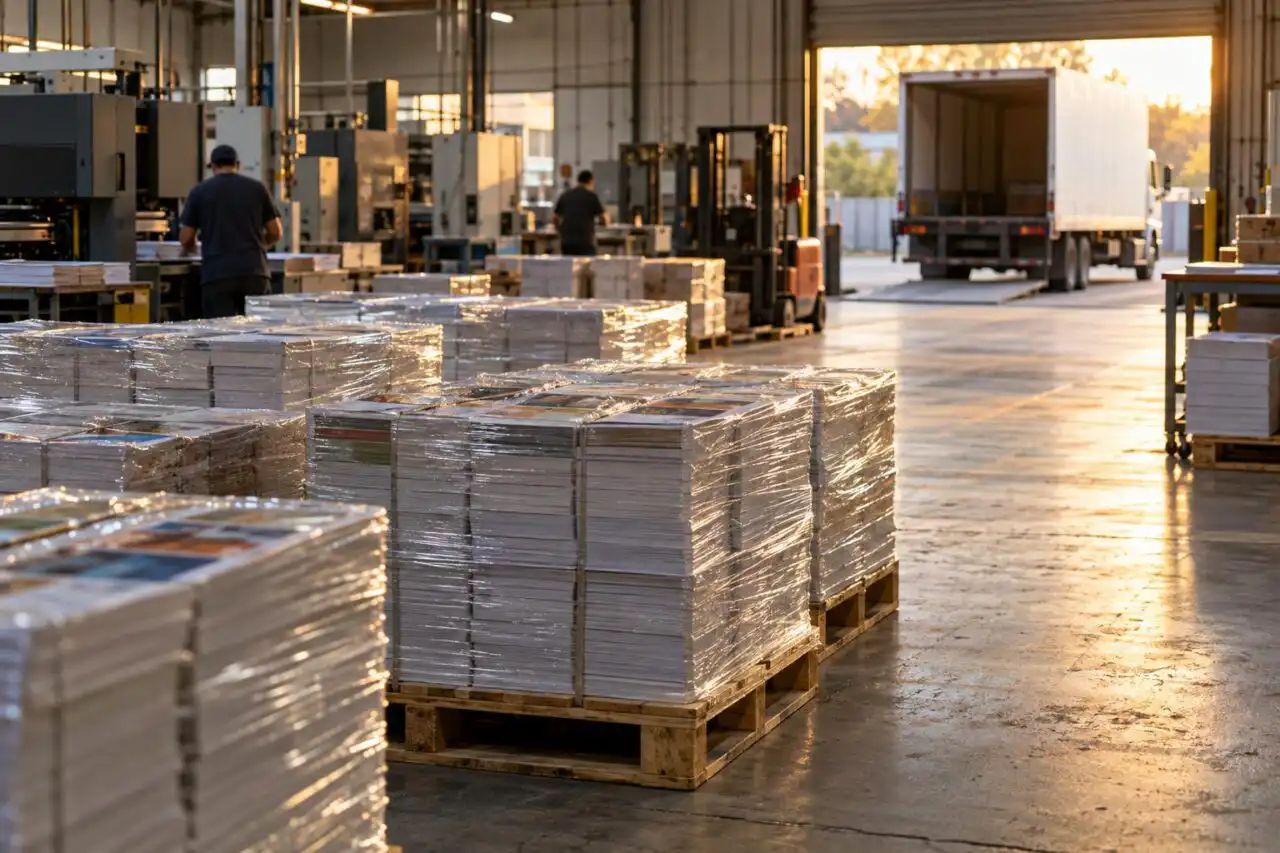
A print job is finished the moment it comes off the press, and completely worthless if it arrives late. That is the part of the business people outside of print tend to miss, and it is why print shop delivery has less in common with ordinary freight than it looks. A catalog that shows up two days after the mail drop date, a banner that reaches the convention center after move-in closes, a run of point of purchase displays that lands the week after the promotion started, all of it had the same production quality as a job that arrived on time. The only difference was the delivery.
Print shops across Florida carry that risk on every job, and many of them carry it with a carrier who treats their freight like any other pallet on the truck. That is where the deadlines start slipping.
Why Print Freight Does Not Behave Like Other Freight
Most freight has a delivery window measured in days. Print freight has one measured in hours, and it is usually set by something nobody involved can move. A direct mail job has a drop date at the postal facility. A trade show job has a move-in window that closes whether your crates are inside or not. A retail promotion has a start date that was printed in the circular weeks ago.
None of those dates care that the truck was waiting on three more stops to fill out a route. When a print shop misses one, the conversation with the client is not about freight. It is about whether the shop can be trusted with the next job.
The Problem With Waiting for a Route to Fill
Standard LTL freight works by consolidation. Your pallets ride with other shippers’ pallets, the truck runs when it is full enough to be worth running, and the freight moves through terminals along the way. For plenty of cargo that is a sensible trade. For print it introduces two problems at once.
The first is timing. A load that leaves when the truck fills is a load with no reliable departure time. The second is handling. Every terminal stop is another place a skid of finished print gets moved, restacked, and occasionally damaged. Printed goods are unusually easy to ruin. A corner crush on a pallet of folded cartons, a forklift scuff across a stack of posters, moisture on an uncoated sheet, and the job becomes a reprint.
What a Dedicated Run Does for a Print Deadline
A dedicated delivery is a single truck carrying a single customer’s freight, direct from pickup to delivery. No commingled freight, no terminal stops, no waiting for the trailer to fill out with somebody else’s pallets.
For a print shop that changes the planning math. The departure time is yours, so the job leaves when the bindery finishes rather than when a route is ready. The freight is touched at pickup and at delivery and essentially nowhere in between, which is the single biggest reduction in damage risk available. And because the load never changes hands, one carrier is accountable for the delivery window instead of a chain of them pointing at each other.
Mailers, Catalogs, and Drop Date Freight
Direct mail is the least forgiving work in print logistics, because the deadline belongs to the postal system rather than to the client. A drop date is an appointment. Miss it and the job does not simply arrive late, it gets rescheduled into a slot that may be days out, and the campaign timing the client paid for is gone.
Drop shipments also tend to be awkward freight. They go to a specific facility, on a specific day, often inside a specific window, and sometimes to several facilities at once from a single run. That is work that rewards a carrier who can plan the route around your job rather than slot it into an existing one.
Large Format, Signage, and Display Work
Large format print brings a different problem. The freight is physically difficult before it is time sensitive. Rigid substrates, mounted graphics, fabric displays on frames, and finished signage are bulky, fragile, and frequently going somewhere without a loading dock.
A convention center, a retail storefront mid remodel, a hotel ballroom, or a job site rarely has the equipment to take a standard trailer delivery. That is where liftgate delivery stops being an upgrade and becomes the difference between a completed delivery and a truck that has to come back tomorrow. For installed work and anything going straight onto a show floor, white glove handling covers the part of the job that happens after the doors open.
Moving Print Between South Florida and Central Florida
A good deal of Florida print work is produced in one metro and consumed in the other. A shop in Miami printing for an Orlando convention, a Central Florida shop running a retail program for South Florida stores, a job that has to be in both markets the same week.
The usual way that freight moves is by interlining, which means handing the load from one carrier to another somewhere in the middle. Every handoff is a point where the timeline can slip and where nobody owns the problem. Comet’s Miami to Orlando linehaul runs between its own two hubs, so freight crossing the state stays with one carrier end to end.
What to Look for in a Print Shop Delivery Partner
The questions worth asking are narrower than most carrier conversations get. Can you commit to a departure time rather than a service window. How many times will this freight be handled between my dock and the delivery address. Who do I call at four in the afternoon when a drop date is at risk.
It is also worth asking what happens when a job goes wrong on your end, because sometimes it does. A press breaks, a proof comes back late, and a run that was supposed to ship Tuesday is ready Thursday night. A carrier who can put hot shot or expedited capacity against that without renegotiating the whole relationship is worth more than the rate difference on routine runs.
Talk to Comet About Your Print Deliveries
Comet has been moving freight for Florida businesses since 1977, and print has been one of its core verticals for most of that time. Dedicated runs out of hubs in Miami and Orlando, serving the whole state, with freight staying on one carrier from the pickup to the delivery address.
If your shop has a lane where deadlines keep coming down to luck, that is usually the first one worth changing. Contact us to talk through your drop dates and delivery windows, or see how Comet has run Florida freight since 1977.
