
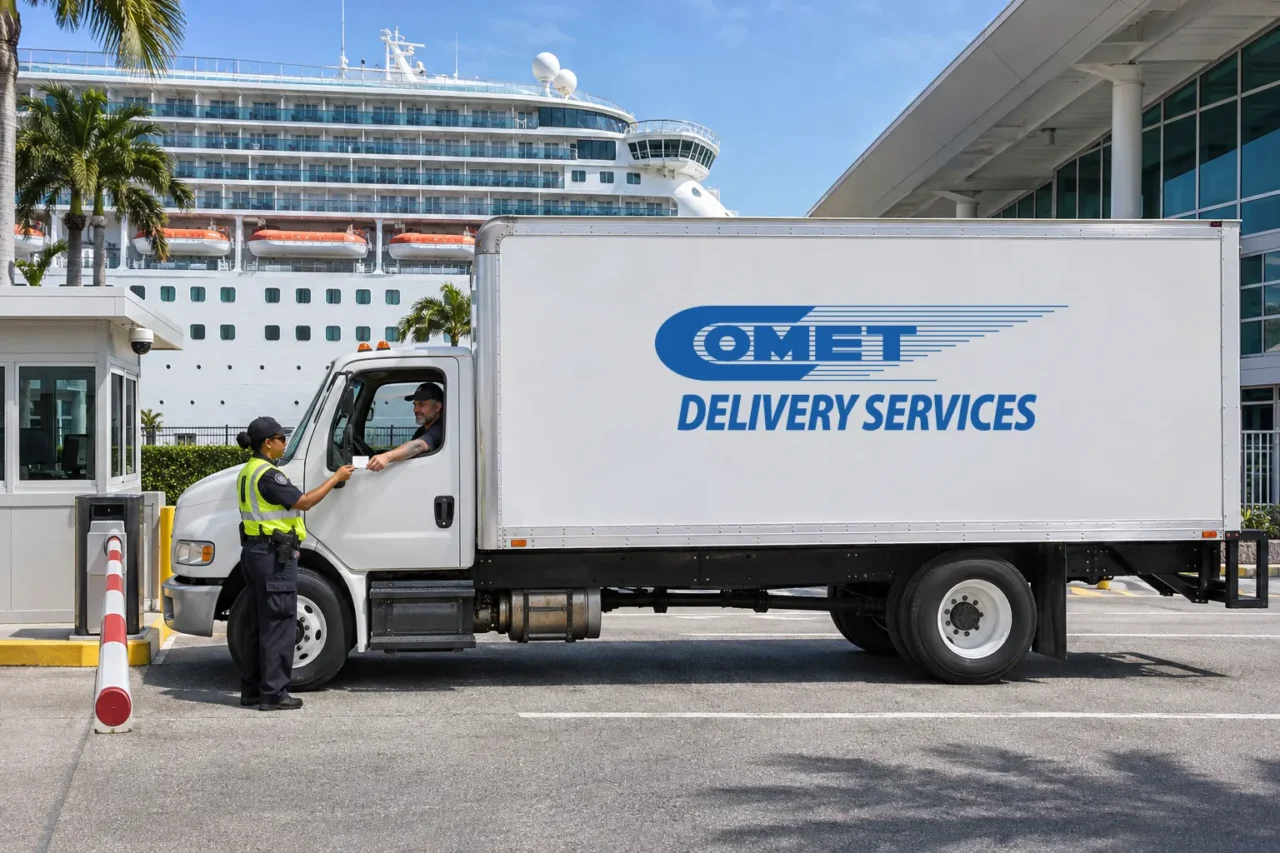
A shipment is ready at an airline’s cargo facility at Miami International, or a load of provisions has to reach a cruise terminal before the ship sails, and somewhere in the planning someone asks whether the drivers have TSA vetting and a TWIC card. It reads like a box on a vendor form, and it decides whether the truck drives straight to the dock or sits at the gate while somebody works out who is allowed in.
Both credentials belong to the person behind the wheel, and each one clears that person for a specific kind of secure area. Knowing what they cover tells you where the delays come from and what to ask before you book.
What a TWIC Card Clears Drivers to Do
TWIC stands for Transportation Worker Identification Credential. The Maritime Transportation Security Act requires it for workers who need unescorted access to the secure areas of regulated port facilities and vessels. TSA issues the card after a security threat assessment, which is a background check, and applicants are fingerprinted and photographed when they enroll. The card is valid for five years from the date it is issued. Most seaports add a credential of their own: PortMiami and Port Everglades each issue a port ID badge to TWIC holders, so a driver working those terminals typically carries the port’s ID as well as the TWIC.
Each terminal defines its own secure areas under a security plan approved by the Coast Guard, and that includes the cargo and cruise terminals at Florida’s seaports. The card does not override the terminal’s rules on who comes in and when, but without it a driver cannot move through a secure area alone at all.
What Happens at the Gate Without One
Federal rules are specific about the alternative. Someone without a TWIC can enter a secure area only under escort, and in the more restricted areas that means a card holder at their side the entire time. Either way, the terminal has to arrange the escort, someone has to be free to do it, and the truck waits until they are.
The other option is a handoff. The freight comes off the first truck at the perimeter and goes onto a truck with a credentialed driver, which adds a second carrier, more handling, and a second schedule to line up. Either way the delay lands where the timeline is tightest, in the last stretch before the dock. A carded driver skips both and takes the load through. On Comet’s port runs, the driver carries a TWIC card and the port ID the terminal requires, and takes the truck through the gate without waiting on an escort.
The TSA Side of Airport Cargo
Airports work differently. Tendering freight to an airline does not take an additional airport badge: the driver brings the load to the airline’s cargo facility. What applies there is TSA’s air cargo security program, which covers airlines and the freight forwarders that hand cargo to them, known as indirect air carriers. Anyone with unescorted access to cargo under one of those programs goes through a TSA security threat assessment first.
On a ground-side run, the work happens at the cargo facility: tendering outbound freight before the cutoff, or recovering freight once the airline releases it. Comet’s airport cargo pickup and delivery covers that leg on the road and leaves the flight to the airline. When the driver’s vetting is already in place, outbound freight being tendered for a flight does not stall over who is permitted to handle it.
Cruise Terminals Run on the Ship’s Clock
Cruise freight is the clearest case for credentials, because the deadline belongs to the ship. Provisions, spare parts, and onboard retail stock have to reach the pier and load during a turnaround measured in hours. A truck held at the gate for an escort is losing its place in that window.
That is why cruise ship logistics at PortMiami, Port Everglades, and Port Canaveral depends on drivers who carry TWIC cards. With a carded driver, the truck that left the supplier’s dock is the one that reaches the ship, and nobody has to stage a transfer outside the gate.
Credentials Belong to the Driver, Not the Carrier
A TWIC is issued to a person, and so is a TSA security threat assessment. A carrier can truthfully say it runs TWIC card drivers and still send one without a card to your load, and a broker passing the job to whoever has a truck free that day may not know which driver is coming at all. And an expired card counts for nothing at the gate.
Dedicated delivery closes that gap on secure runs. A dedicated truck carries one customer’s freight, and Comet handles the move as one carrier from pickup to delivery, so the credentialed driver dispatched to your load is the driver who arrives at the gate.
Bonded Status Is a Separate Qualification
Freight that needs a carded driver is often international too, landing at MIA or coming off a vessel at PortMiami before it has cleared customs. Credentials get the driver to the freight. Operating as a US Customs bonded carrier lets a carrier move that freight in bond, under seal and with its paperwork, to a bonded warehouse or customs facility. Driver credentials and bonded status are separate qualifications, and one shipment can need both.
Comet is a bonded carrier and runs freight with TSA and TWIC carded drivers, so an international recovery stays with one carrier from the airport or port to the bonded facility, then on to its destination once released. Timing is the other half of any port job, and planning a port pickup around vessel offloading and gate traffic keeps a credentialed driver from arriving before the freight is ready.
Questions to Ask Before You Book a Secure Run
A few direct questions settle most of the risk before you book. Does the driver assigned to this load carry a current TWIC and the port’s own ID for that terminal? For airport work, has that driver completed the TSA vetting the cargo facility requires? Will the same carrier take the freight from pickup to delivery, or is a handoff planned anywhere along the way?
Then give dispatch everything up front: the terminal or cargo facility, the loading window or tender cutoff, the air waybill or booking reference, the piece count, and whether anything is moving in bond. If the window is already tight, an expedited run on a dedicated truck closes the gap between freight that is ready and a deadline that will not move.
Talk to Comet About Your Next Airport or Port Run
From MIA, MCO, and FLL to PortMiami, Port Everglades, and Port Canaveral, Comet’s Miami and Orlando hubs cover the airports and seaports where credentials decide how fast freight moves. That means fewer stops at the gate and no handoffs at the perimeter.
If your freight is headed for a secure terminal, the first thing to settle is who will drive it. Contact us with the terminal and the timing, or see how Comet runs secure, dedicated freight.
